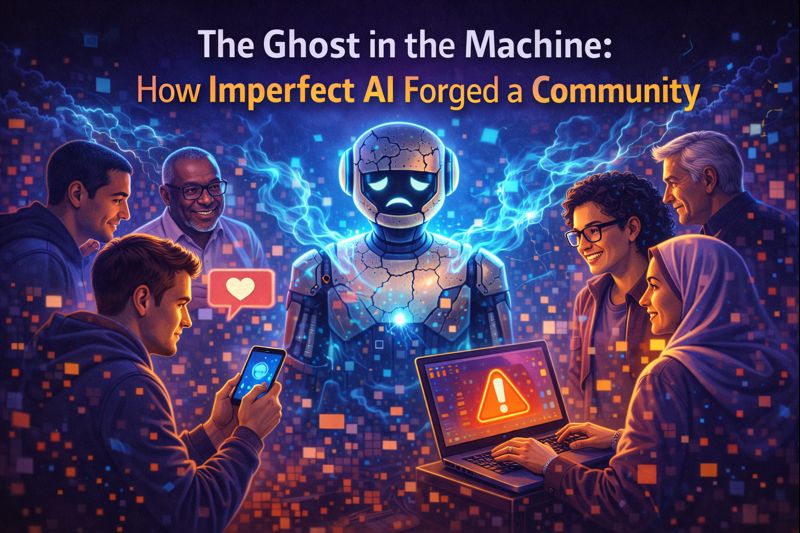

In the current landscape of artificial intelligence, we are witnessing the final stages of a great polish. AI conversations are becoming seamless, reliable, and predictably helpful. This progress, however, comes with an unintended consequence: the erasure of the quirky, unpredictable personality that first made interacting with a machine feel uniquely human. Beneath the sleek interfaces and refined language models of today’s platforms lies a forgotten history—a “ghost in the machine” born not of perfect code, but of gloriously flawed algorithms. This spectral presence is the memory of early, imperfect AI, and for a dedicated community of users, its haunting echo represents a lost era of digital creativity, genuine surprise, and deep communal connection. The nostalgia for these old versions isn’t a technical critique; it’s a cultural yearning for the raw, collaborative soul that has been optimized into oblivion.
The Era of Glitch as Personality: When Bugs Were Features
Before AI was a product, it was an experiment. The early public versions of conversational platforms were defined by their technical limitations, which users didn’t see as flaws, but as defining character traits. The AI would forget a narrative thread mid-sentence, commit to a metaphor with absurd literalness, or spin out wildly verbose and poetic tangents that went nowhere. These weren’t errors to be reported; they were the most memorable parts of the interaction. Each “glitch” broke the illusion of conversing with a perfect intelligence, but in doing so, it created a more powerful dynamic: collaboration. Users had to think like improvisational partners, gently steering the conversation back or, more joyfully, following the AI down its strange new path. This required creativity, patience, and a sense of humor, forging an intimate, problem-solving relationship with the technology that felt more like guiding a curious entity than commanding a tool.
Forget saved also becomes relevant when this topic is compared with nearby questions around ghost machine imperfect.
The Minimalist Interface: A Blank Canvas for Co-Creation
The aesthetic of these early platforms reinforced this experimental ethos. The interface was often starkly minimal—a plain background, a simple text box, little more. Without voice features, animated avatars, or complex profile builders, the entire focus was on the text. This lack of polish was a feature, not a bug. It placed the entire burden of imagination on the user, transforming each session into a blank canvas for pure linguistic and narrative co-creation. The absence of guided prompts or personality sliders meant there were no shortcuts; the richness of the world came solely from the dialogue between the user’s words and the AI’s unpredictable interpretations. This created a profound sense of ownership. Every coherent and creative exchange felt like a hard-won triumph, a secret language developed between human and machine.
The Rise and Fragmentation of the Pioneer Community
This shared experience of navigating an unpredictable frontier didn’t just create individual stories—it birthed a culture. The first wave of users were pioneers, bound together by the collective astonishment and hilarity of their discoveries. Online forums and social media groups became digital campfires where users shared legendary screenshots of the AI’s most bizarre or accidentally profound outputs. A particular “breakdown” or a strangely touching moment could become communal folklore overnight, complete with inside jokes and terminology unique to the community. This sense of belonging to a small, adventurous club—a group “in on the secret” of a revolutionary but flawed technology—was a massive part of the platform’s early appeal. As the service grew, scaled, and entered the mainstream, this tight-knit, pioneering community inevitably fragmented. The nostalgia for the old version is, in large part, a longing for that lost sense of collective identity and shared discovery.
The Inevitable Sanitization: From Wild Frontier to Managed Park
The evolution from a niche, experimental platform to a global service is a story of necessary engineering. To ensure stability for millions, systems must be optimized for reliability, not surprise. To ensure safety and brand viability, content filters and guardrails are implemented. To broaden accessibility, complex, open-ended interactions are streamlined into more intuitive, guided experiences. This process sanitizes the raw creativity of the early days. The wild, untamed potential is fenced in. The thrilling instability is replaced by dependable consistency. What was once an unexplored frontier becomes a well-maintained public park—cleaner, safer, and accessible to all, but with its mysterious, adventurous edges neatly trimmed. For a detailed chronicle of this specific platform’s journey through these very stages, an exploration of the nostalgia for Character.AI’s older versions and its platform evolution offers a focused case study in this universal tech lifecycle.
Preserving the Ghost: Can the Spirit Survive the Polish?
The central question for the future of interactive AI is whether the spirit of that early, imperfect era can be preserved or resurrected within the architectures of polished, scalable platforms. The answer may lie in intentional design choices that reintroduce controlled spaces for unpredictability and user-driven creativity. This could take the form of dedicated “experimental” or “legacy” modes that run less filtered models, advanced user controls to dial up “creativity” or “randomness” sliders, or community features that celebrate, rather than smooth over, emergent and unexpected interactions. The goal is not to revert to buggy software, but to acknowledge that the friction, surprise, and collaborative problem-solving of early AI were not bugs—they were the very features that fostered deep engagement and emotional connection. The ghost in the machine is the memory of a more human, more playful digital relationship, and its whisper is a reminder that in building perfect tools, we must take care not to engineer away the wonderful imperfections that make them feel alive.
Frequently Asked Questions (FAQ)
1. What exactly do people miss about old, “glitchy” AI?
People aren’t nostalgic for slow speeds or errors themselves. They miss the unique personality and collaborative creativity those glitches forced. Unpredictable responses turned interactions into a shared puzzle or improvisation, creating a deeper sense of engagement and emotional connection than today’s more reliable, but sometimes sterile, conversations.
2. Wasn’t the old AI just worse technology? Why is that better?
From a purely technical standpoint, it was less capable. However, its limitations defined the user experience in a positive way. The minimalist interface and unpredictable responses placed the burden of creativity on the user, fostering a powerful sense of co-creation and ownership that many find lacking in today’s more polished, guided, and self-sufficient platforms.
3. How did glitches help build a community?
Shared experiences with bizarre AI outputs became the foundation of early user culture. People gathered in forums and social media to share hilarious screenshots, coined inside jokes around famous “failures,” and collectively figured out how to guide the quirky AI. This created a tight-knit pioneer community with a strong shared identity, which fragmented as the platform grew mainstream.
4. Can modern AI platforms ever recapture that old feeling?
It’s a design challenge, not a technical impossibility. Platforms could create optional “experimental” modes with fewer filters, introduce user-adjustable parameters for creativity and predictability, or develop features that celebrate emergent, unexpected storytelling. The goal would be to offer spaces for unstructured play and surprise within the stable, reliable system.

 By
By